Showing posts with label Biblical worldview. Show all posts

Monday, March 11, 2013

Got Farkles?

Obi-wan and Black Widow on the run
Yesterday my twelve year old and I were having an in-depth conversation. I had been watching The Island during my workouts, and he slipped in and watched with me.

If you haven't seen it, The Island is an underrated film dealing with a lot of ethical issues. The definition of life, the value of life, and the potential future medical dilemmas make for interesting mental fodder. (There are plenty of explosions and helicopter chases Mark, so it's up your alley as well :D).

My son and I discussed some of the implications of the movie. He made the comment, "Boy, if I could talk to everyone about their worldview, I could agree with all of them."

This statement surprised me.

We've taken care to teach our kids about worldview and what it means to have a Biblical worldview. We use the book Who Is God? (And Can I Really Know Him?) to teach them about God and His character and ways. I thought we'd done a lot to inform them about this kind of thing.

I talked to him about worldviews and how everyone has one, but if anyone can make their own standards, how can we know what is true. Is there an objective standard?

I grabbed a ruler and measured my water jug. It was 8 inches high. I then told him about a guy who didn't like inches, so he made up a new measurement: farkles. According to these measurements, the jug was 15 farkles high.

Which one is right? How do we know what farkles are?

My analogy has some holes. Inches are arbitrary as well. Still, I showed him how we can be confused if we all appeal to a different standard. If the Bible is truly what it says it is, the revealed Word of God, then we have a standard from the One who made everything and is worthy to establish an objective measurement.

Hopefully my message got through. It made me realize that we have to be diligent in always training our kids up in truth and pointing them to Jesus. I ended with saying that I believe the Bible to be our standard and living for Jesus to be our ideal-but that I couldn't make my son believe the same things. He would need an encounter with God on his own, that he was responsible for his own walk with God. I can lead them to water, but I can't make them drink, as the old saying goes.

Anyway, I'll keep training them as best I can, and pray that they will be able to grab hold of Jesus and all He has for them in their lives. That's the frustrating thing about being a parent. No matter how much you value something, you can't force things on your kids. They need to come to their own understanding of it. I believe it will happen for my children.

I just wish it would hurry up. ;)

---

Wednesday, December 12, 2012

The Definition Of Christian Fiction

Now this is interesting...

There was a very interesting confluence of circumstances in the world of Christian or CBA fiction this week. First of all, I am a member of the American Christian Fiction Writers (ACFW) and I subscribe to the main email loop for discussion of issues in Christian fiction. I haven't been following it for a while, but this week I happened to open up my digest and there was an interesting (if not new) discussion.

How "Christian" should our stories be?

Larry Timm started the discussion with this question on his blog and he threw it out to the ACFW loop as well. Both the comments on Larry's post and the answers on the email loop were enlightening.

The answers varied, for sure. Some thought that Christian novels should explicitly glorify Jesus in some way. Being a sweet romance without profanity or sex wasn't enough. Some answers thought there should be some lesson or purpose in the story. Others wondered if their stories could be considered Christian if there wasn't a path to redemption/salvation shown clearly in the text. There was concern that the message may be watered down in the current climate to appeal to wider audiences.

Is it enough if the worldview Christian, if the characters are Christians and live, make mistakes, and learn from their sin, without preaching it to the reader? Is there a place for good, clean fun, or do they all have to change our lives somehow? I liked what Randy Ingermanson said, something to the effect that we're called to be salt, but people like different levels of saltiness in their soup.

The consensus seemed to move toward different stories for different folks. Authors may be called to tell stories with the themes veiled or more subtle, while others may want to specifically deal with a theological/moral topic. People were respectful. It is an old debate in the CBA world, and it will continue to recycle as long as we continue to write.

What made the timing interesting to me was the introduction  this week of...The Hinterlands.

Marcher Lord Press has developed a significant niche in the CBA world as the go-to place for Christian speculative fiction. Other publishers will produce some science fiction or fantasy, but no one sells out for it like MLP.

Now they are ready to push the boundaries - figuratively and literally, it seems.

Hinterlands is the new MLP imprint for mature fantasy and sci-fi. It is designed to reach out to people who love secular fantasy/sci-fi but wouldn't pick up a typical Christian novel. The first book is called A Throne Of Bones by Vox Day, and it is specifically targeted to be for fans of epic fantasy such as George R. R. Martin and his Game Of Thrones series.

According to an article in Christian Retailing, Hinterlands will feature books with content that does not always mesh with traditional CBA fare.
“Just as some Christians have the ability to watch R-rated movies without stumbling and others do not, so it will be with A Throne of Bones and other titles to come in the Hinterlands line,” [Jeff Gerke] said.

MLP's owner and publisher Jeff Gerke went on to say,
“It’s not going to be erotica, and the characters aren’t going to be dropping f-bombs left and right,” he said. “But these books will still have more mature content than other Christian novels. Having these books in their own imprint will allow our fans to find the Marcher Lord Press books they’re interested in and avoid the ones they would rather avoid.”
“Hinterlands books may contain vulgarity, profanity, nudity and/or sexual content, but never for gratuitous purposes. Hinterlands allows us to pursue crossover publishing that will put the word of the gospel before people who would never otherwise pick up a Christian novel. It also allows us to examine mature themes in a realistic manner that some Christians will appreciate. We know that not everyone will want to read these books, so we have set them apart into the Hinterlands imprint.”

So we have two separate streams in the CBA realm that may be flowing in parallel, or depending on your viewpoint, moving far away from each other.

One side sees Christian fiction as standing apart from the world. Generally this group sees Christian fiction through the lens of Philippians 4:8, wants to see a clear story of redemption or salvation, and hews to an evangelical Christian framework.

Hinterlands is new ground that is trying to engage the world in realistic ways. This imprint could be the publishing home for stories from the Bible like Judges, Genesis 34 or 38, or be a realistic portrayal of life of King David. It sounds like they will take great care to avoid gratiutous use of profanity, violence, or sexual situations, but they won't avoid it wholesale if the story seems to require it.

I am very interested in seeing how this plays out. Can MLP succeed in this bold initiative with Hinterlands? Is there room for Christians producing this type of literature? At least, is there room in the CBA world? With the new world of the internet and social media, perhaps the old forms of marketing and distribution aren't needed anymore, and a niche like Hinterlands can succeed and reach people.

Can we reach people with gritty stories? This question has been debated in the CBA for a while now. I guess we'll be finding out with Hinterlands.
---
What do you think? I've got my opinions for a later post, but I want to hear from authors and readers of Christian fiction and speculative fiction. What is Christian fiction, and is there room for Hinterlands-type books in it?
---

Wednesday, October 24, 2012

CSFF Tour Day 3 - The Spirit Well

In Which The End Game Becomes Visible, If Only For A Moment.

The CSFF Tour is wrapping up our feature of The Spirit Well, the third book in the Bright Empires series by Stephen Lawhead.

This mind-bending series is a fascinating mash-up of quantum physics, historical mystery, and pre-Starbucks coffee culture with an Indiana Jones twist. Lawhead is a gifted writer and this ambitious five book set challenges his readers with a forth and back approach as the characters wind through multiple dimensions stretching from Macau to ancient Egypt to modern day London and even the Stone Age.

This is all well and good, but if this is the Christian Sci-Fi and Fantasy tour, where is the Christian part?

There have been praying monks and characters who mention God, but there is also a mysterious well with resurrection-like power and the pesky dimension-hopping that seems to contradict things we know. Why is this series published by a Christian publishing house?

The Spirit Well gives us our first substantial insight into the spiritual underpinnings of the series on pages 304-305. Cassandra Clarke is a young paleontologist who was swept up by this dimensional traveling to 1930's Damascus and has met up with two strange people from the Zetetic Society. She is being asked to join this group in their quest to encourage the "transformation of the universe." The society members are afraid that reaching a special landmark called the Omega Point will be thwarted by the enemies of good unless the Society can succeed.

The skeptical scientist points out a fallacy at this:
"So," concluded Cass, "Almighty God is not strong enough alone to bring about His purpose for the universe. He needs you and your society to make it happen; otherwise it has all been for nothing. Is that what you're saying?"
That isn't the end of it. Cassandra voices a reasonable doubt at what she's being told. Still, her experience of traveling through time and space has changed her paradigm already. The beauty of what has happened so far in the Bright Empires series is brought out by the elderly Mrs. Peelstick in response:
"...God has always worked through the small, the insignificant, the powerless - it seems to be sewn into the very fabric of the universe...
...Over and over again, we see that when anyone willingly gives whatever resources they have to Him - whether it is nothing more than five smooth stones gathered from a dry streambed or five little loaves of bread and two dried sprats - then God's greater purpose can proceed...
...And one poor, wandering country preacher - homeless, penniless, friendless, and despised by all but a handful of no-account fishermen and a few women - gave himself so fully to God that the combined might of the two most powerful forces in his world - the Roman empire and the religious authorities - could not stop him."
One simple speech, expertly seated in the mid-point of the series, anchors this tale in the ways of the Almighty God. Stephen Lawhead has been writing at a high level for many years. He didn't reveal the spiritual underpinnings right away. The wait made it more poignant when it finally came. Patience is a powerful weapon for the author.

We may want to rush to make it known that our work points to Jesus. I think it is better when it is placed in the proper context. After 2.75 of the series, we finally see the glow of the Light of the world. It is not dwelled upon. The characters move on. But the wait is worth it. The impact left me with a highly satisfied feeling, seeing an image in the tapestry pop out after it was just out of view the whole time.

Sure, the dimensional aspect is not in our usual understanding - but this is speculative fiction after all.

There's something to perseverance, both in writing and in reading. Lawhead stated he's waited 15 years to write this book, and just now feels he can do it justice. I'm thankful that an enjoyable yarn has such a careful craftsman at the helm.

Does this book sound interesting to you? Leave your thoughts below. Be sure to check out the other blogs posting. Becky Miller keeps a list of the posts for you.

We'll see you next month. Unless one of us stumbles upon an active ley line first...
---

Monday, October 08, 2012

The Just Church

He has shown you, O mortal, what is good.

And what does the Lord require of you?

To act justly and to love mercy

and to walk humbly with your God.  

The words of the prophet Micah are spoken in churches all over the world. Believers love this simple declarations of what Jesus asks of His people.  

Christians try hard to walk humbly with the Lord. We strive to show mercy to people. However, we often ignore or struggle with the clause of "acting justly." Especially for Western Christians, the command for justice is flat-out missed or simply misunderstood.  

There is a new move of the Spirit, awakening His people to the need to provide justice for those who cannot speak up for themselves, to proclaim freedom to the captives, to minister to the widow and orphan. It is a slow burn, but it is exciting to see the embers leaping into flame in various places of the body.

 A new spark is being provided by the new book The Just Church by Jim Martin of the organization International Justice Mission (IJM).

IJM has been fighting for justice for many years now and is one of the leading organizations battling injustices like forced labor, human trafficking, sexual exploitation of women and children, and modern-day slavery in all its forms.  

Jim Martin has been working with them after transitioning out of the pastoral role in his church, becoming a church liason with IJM. This experience made him especially qualified to write The Just Church.  

This book is a challenge to the body of Christ to reclaim the lost aspect of Micah 6:8 and to actively act justly in the world. There are other books that try to awaken Christians to the need of justice and to expose the problems of modern slavery and other forms of bondage towards vulnerable peoples that is easy to overlook in our daily lives. The Just Church is a book that takes the church on journey to forming a viable justice ministry to compliment evangelism and mercy ministry.  

The book is laid out in three sections. The first section establishes a theory that faith doesn't really grow without significant risk and suggests that justice ministry is a needed part of the church and can help develop a healthier discipleship in His people. The second section takes the reader through a practical journey on establishing a justice ministry in the local church. It isn't a step by step approach, allowing for the individual characteristics of any body guide the process. The last part of the book is a series of appendices with Scriptures on justice, resources for following through, and study materials. Each chapter ends with a QR code that can be scanned by a smart phone or tablet, leading to a video with Jim summarizing each chapter's main point.  

It is well-written with an easy conversational style. Jim lays out the challenges inherit in this type of ministry and doesn't sugar-coat it. It won't be easy. But he recognizes the hope that is out there for people if Christians will rise up and stand in this gap, so the book is infused with this balance of challenge and hope.  

Any critiques are minor. The videos are a very nice multimedia touch in this day and age - but I'm a fast reader so I'd rather not slow down and watch a movie. Those who like this feature will be pleased. Also, sometimes the book seems too much like a selling tool for IJM. I realize Jim works with them and is most familiar with their work, but there are other fine organizations out there doing similar work as well. This isn't a big issue, and I support IJM financially myself.  

Overall I am thrilled to have had a chance to read this book and see the new horizons coming in the fight against injustice. The need is starting to become known in the western Church. The Just Church takes the movement to the next step and provides a practical tool to those churches looking into how they can join in the justice ministry sphere. It isn't for special groups like IJM or others listed on my links on my blog. The Bible speaks very clearly about God's love of justice and it is every Christian's responsibility to see the threefold thrust of Micah 6:8 walked out in the world today.  

I'm thankful to Jim Martin and IJM for their work. I did receive a preview copy for promotional purposes, without any expectation of a positive review. My endorsement is heartfelt. The Just Church is a powerful tool in the battle against modern injustice. I highly recommend it.
 ---

Wednesday, September 26, 2012

CSFF Tour Day 3 - The Telling by Mike Duran

I left off last time on our CSFF tour feature of The Telling by Mike Duran with a teaser. I reviewed the book, but didn't address the main idea of the book.

That requires a post of its own.

Mike's main character has a gift he calls "the Telling." It is basically prophecy - he gets words for people or others. It often comes with a physical sensation that makes him sick.

Prophecy isn't controversial, is it?

The problem in the book is the ninth gate of hell that happens to be nearby and is threatening to take over the small California town of Endurance.

A gate of hell isn't controversial, is it?

The demons that infiltrate Endurance make copies of people's bodies, creepy doppelgangers that know the person's every thought and desire.

That isn't controversial, is it?

None of this would be controversial if it weren't in the Christian fiction arena. The thing that could make it very risky is that there is a clear representation of faith and needing God's touch in the midst of more unorthodox aspects of the story.

I don't want to spoil the story, but needless to say Zeph Walker has some issues since he has a huge scar marring his mouth inflicted by a psychotic stepmother. After being hurt, he stopped using the Telling - or it left him. Either way, there's a theme of finding your way back to faith. The tagline for the book is awesome: A prophet never loses his calling, only his way.

So the theme of coming back is a decidedly Christian one. However, since The Telling mixes God with mythical gates of hell, demons that don't possess but make really good paper mache copies of people, strange demon fighters, and a blend of science and the occult - is it truly Christian fiction?

I say yes.

I don't believe a novel has to be orthodox to be Christian fiction. Maybe it comes from too much familiarity with Mike Duran - I know that he loves Jesus and loves the Church and the Word. But we have a huge precedent with C.S. Lewis and the Chronicles of Narnia. Witches and talking horses and all sorts of magic run through the story, yet all but the most conservative of Christians accept it as one of the prime examples of exemplary Christian fiction. Even though J.R.R. Tolkien didn't claim to be writing Christian fiction with The Lord Of The Rings, it is still considered a more veiled version of Narnia.

I know others will disagree. We had a fine gentleman with good thoughts leave the CSFF because too many stories we featured weren't orthodox enough for him. So whose orthodoxy will we use? In mine, prophecy is good to go, but other Christians won't agree to that at all. This will continue to be an issue no matter what we do.

I wish I had been able to visit the other blogs on the tour and see the chatter. Unfortunately between computer glitches and backed-up sewer lines in basements (honey, let's do a spontaneous renovation of the downstairs) I haven't seen much of anything. I aim to fix that and check out the opinions, because I'm sure this is going to be an interesting conversation. As always, our stalwart leader Becky Miller keeps up with the latest and greatest posts of the tour.
  
---

Monday, September 24, 2012

CSFF Tour Day 1 - The Telling by Mike Duran

 It's time to "Tell" you about the September Christian Sci-fi and Fantasy Tour.

This one is a pleasure for me because the CSFF is featuring Mike Duran and his latest novel, The Telling.

Mike Duran is an author and prolific blogger. His blog Decompose is a fertile ground of ideas that make you think. Not only does Mike post provocative thoughts on faith, fiction, and culture, but the community of commenters he has following him often expand the posts into very interesting realms.

Mike is not afraid to ask the hard questions or probe issues regarding Christian fiction and speculative ideas. However, he has a deep love for the Church and regularly pokes at the foibles of atheist and relativistic thinking.

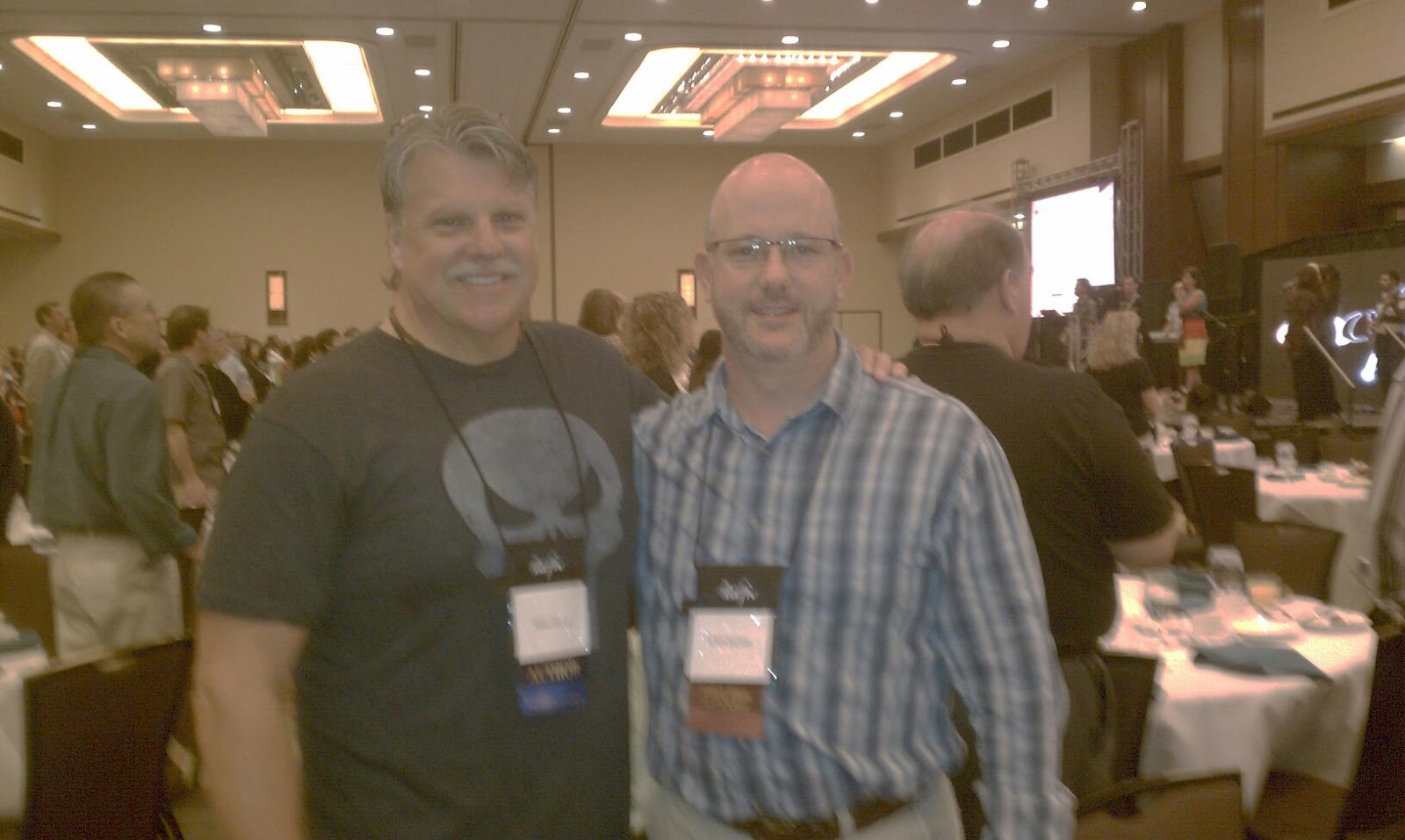
Mike and I chatting it up
The best part about Mike is that he is real and he is interested in people and exploring these issues. I know this because I had the great pleasure of meeting him this last weekend at the ACFW Conference in Dallas.

If this post sounds gushing because I just met the guy and I'm talking him up, you can forget that idea. The web does not allow for really knowing people, no matter how much you think it does. The face-to-face with Mike and bouncing ideas off him and other like thinkers (here's a shout to fellow CSFF tour member Morgan Busse) over meals was a highlight of the conference to me.

Over the next few days we'll be talking about Mike and The Telling. I'm sure it will be a tour with a lot of discussion. I invite you to check out my fellow tourmates below for more information.


 Jim Armstrong
Noah Arsenault
Keanan Brand
Beckie Burnham
Brenda Castro
Jeff Chapman
Christine
Theresa Dunlap
Victor Gentile
Nikole Hahn
Bruce Hennigan
Julie
Carol Keen
Emileigh Latham
Meagan @ Blooming with Books
Rebecca LuElla Miller
Anna Mittower
Kathleen Smith
Donna Swanson
Jessica Thomas
Steve Trower
Dona Watson
Shane Werlinger
Phyllis Wheeler
--- 

Wednesday, September 14, 2011

A Christian Artist Who Isn't

I'd like to introduce you to a lovely young woman from New Zealand.

Brooke Fraser.

You may not be familiar with her. She's a singer/songwriter who is gaining an international reputation for her thoughtful, creative music. Hopefully you will become acquainted with her, because her songs are quite beautiful, with a unique sound and a touch of whimsy.

So why am I talking about a kiwi musician on a writing blog?

I follow the publishing industry in general, but the Christian fiction (CBA) arm specifically. The discussion of what is a Christian artist/writer/book is a never ending cycle of back and forth.

As for Brooke, she seems to have two distinct careers. She has released three albums for the mainstream, each progressively doing better first in New Zealand, then internationally. However, you may have heard her music on Sunday mornings as well. Her songs "Hosanna" and "Desert Song" are known worldwide in contemporary worship services, and she has done worship with Hillsongs United in Australia (sometimes as Brooke Ligertwood, her married name).

The interesting part is this dichotomy, where she is a successful artist to a mainstream audience, and can write and sing for a Christian audience without losing her other identity. When asked about "tension" with these two different worlds, she replies in an interview on an Australian website for Christian music:
You can't put what God is doing on this earth into a box... it can't be summarised into tidy categories. Whatever God is doing through my life, it's not just about me. There's a stirring happening in God's Church, through the creative arts, creative ministries and other things too... and as time moves on we get closer and closer to Jesus coming back. God has a plan for the whole earth and it involves everyone one of us doing our part -- it's not necessarily going to look like something we can easily understand on the natural. I write worship songs that are for the building up of God's people in the Church, and I love that because I'm able to express really clearly, and declare uncompromisingly my love for Jesus. But at the same time I recognise the importance of my other songs as being like parables... taking Church to people who would never walk into a church...


She says in the article that she doesn't consider herself a CCM (Contemporary Christian Music) artist and actually resists it strongly because of concerns about "merchandising the gospel." I know other artists won't identify with CCM because of concerns of being pigeonholed and possibly reducing their audience, but I've never found a major artist who refuses identification with CCM due to such a conviction.

I like the part where she recognizes some of her songs can be directly worshipful, and others are like parables. One of my favorite bands is Switchfoot, and I think many of their songs work in this way.

Songwriting is a different skill than writing fiction, but I believe the ideas brought out by Brooke in her interview and career offer insight to those pursuing writing fiction and wondering where their work fits. I think a fiction example would be Ted Dekker, who is writing best-sellers in the thriller market, while still pursuing stories that speak more directly to a Christian aspect. His books certainly fit a parable.

I know there is a lot to discuss as far as marketing, reaching audiences, and message, but I think having the concept of parable versus being a direct expression of faith in fiction is one to consider.

For my writer friends - where do your stories fit? Parable or more directly speaking to issues of God and faith? What are books that have done both well?
---
Oh, and go check out Brooke's website for some refreshing music!
---

Thursday, September 01, 2011

Beautiful Truth

Thanks to Andrew Peterson on Twitter, I saw this wonderful post about "Proclaiming Truth Beautifully." Trevin Wax takes a post from The Gospel-Driven Church as a launching point to discuss authors who speak truth, but don't just do it from a point of giving information. They give it in an artful way that conveys God's beauty not just via information, but through the language used as well.

Great post - highly recommended. As Trevin ends his post: "May God raise up a generation of writers who not only know the truth, but beckon others to swim in the depths of grace!"
---

Tuesday, July 26, 2011

The Problem With Freedom - Day 3

There is a concept in medicine called "herd immunity."

If you are trying to immunize a population of 100 people against some nasty disease, you don't have to reach everyone with the vaccine. That is hard to achieve. The concept of herd immunity means that if you manage to treat a certain number of the population - for argument's sake we'll say 80 - then the disease does not have enough places to live.

It survives by infecting a host and reproducing, passing itself to the next victim. If one person gets the disease, but doesn't run into one of the other twenty unvaccinated people, then the disease can't continue the process. It will die out in its host whether their immune system takes it out or the host expires. Now there is one less option for spread.

I think the concept of herd immunity is key when discussing sex trafficking and reducing demand.

I've spent the past couple of posts talking about the problem with freedom. (Day 1 and Day 2) To sum up: in Western culture and especially America, we like to say that people should have the freedom to do whatever they want, as long as it doesn't hurt others. The problem becomes that we don't always realize the unintended consequences of our actions, and more people are hurt than we realize.

We may enjoy our chocolate, but the cocoa beans sold to our favorite candy company finance a brutal regime. We may want a purebred puppy, but this supports puppy mills that churns out animals that are unhealthy and contributes to an overpopulation of pets.

Men may think they can look at pornography or solicit sex with a prostitute, and it is only their business. It's not hurting anyone, and they have the right. Right?

My second post on this topic connects the increasing demand for porn and prostitution with the exploitation of children in the sex industry, as does this excellent Newsweek article. I started this whole series because of an article in the Village Voice trying to debunk statistics regarding human trafficking and attacking the campaign by Ashton and Demi's DNA Foundation that wants to eradicate child sex exploitation and trafficking.

I've described the problem. The solution is always harder than identifying the problem.

Men, we have to realize that we are contributing to the exploitation and ruination of thousands of teen girls and vulnerable women. Our lust is providing a disease with plenty of hosts. The young and vulnerable women who are exploited by this industry are the victims, being ravaged by abuse, violence, and neglect. Whereas the DNA Foundation, IJM, Free the Slaves, and GEMS among others work to help these women, the Village Voice continues its defense of its adult services site Backpage.

As the Newsweek article details, the anonymity of the internet has created a huge increase in the demand for sexual buyers. Men think we can do what we want in private without hurting others. Whether downloading items off the net or arranging services at a clandestine location, it is a right. However, it feeds an industry that is devouring more and more of the "herd".

If men would stand up and say "Real Men Don't Buy Girls," if men would realize that these activities are not harmless or private, but contribute to a larger problem, then perhaps we would start seeing some herd immunity develop. If enough men were vaccinated, as it were, then the demand would lessen and there wouldn't be as much exploitation of the vulnerable.

I am not naive enough to believe we can eradicate this problem fully. I do believe we can work to educate men, the demand part of the supply and demand equation, that their actions are harmful and reduce the problem this way. Look at the major public education campaigns in the past:
  • Telling people how HIV is transmitted and how to protect themselves.
  • Reducing CFC's to protect the ozone.
  • Eliminating racist words from being used in mainstream culture.
  • Abolishing the slave trade in the 1800's through William Wilberforce and others.
The problem of men flouting their freedom and fueling a sick industry is real and worsening. People are waking up to this and speaking out, like at the DNA Foundation. The position of the Village Voice is wrong not because I am a religious fanatic or zealot. Their position is wrong because it hurts many people and deserves to be debated and debunked.

Community is not built by everyone having their own way. Community is built by people agreeing to limit themselves for the greater good, by seeing that limits are required to live together and provide true freedom for all.
---

Monday, July 25, 2011

The Problem With Freedom - Day 2

Your freedom can bring oppression to others.

That's my hypothesis for this series of posts. I started off on 7/20 referencing back to the Village Voice article that set off a lot of discussion. An excellent report of the growing demand for prostitution was posted this week by Newsweek, that also points out some of the problems with the Village Voice piece.

There's a issue that the Newsweek article started to expose that the Village Voice completely ignored. Men say they have a right to seek out sexual services, and feminists say that women have the right to offer said services if they want. The issue is that there are a ton of unintended consequences.

The Newsweek article talks about the increase in demand for prostitution. I talked yesterday about how unscrupulous people will work to meet a demand to make a profit. By offering legal services, adults who consent to a sexual transaction drive the problem of underage sexual exploitation.

Pimps who see a way to make a buck will find a way to get a woman out there. They don't care if the girl is underage and not mature enough to really consent. Pimps (whether male or female, there are women who will control other girls for money) will find the vulnerable to exploit. This can be runaways, kids from broken families, drug addicts, or wounded girls who find someone who pays attention to them.

In the very informative book Girls Like Us, Rachel Lloyd discusses the girls who get drawn into the world of sex trafficking in New York City. Many are recruited by men who claim to love them. Maybe a relative will push them out on the street, or make an internet ad to offer them up. In these cases, they don't realize what they're getting into. So women and girls are getting drawn into this violent, dangerous world. From the Newsweek article:
Prostitution has always been risky for women; the average age of death is 34, and the American Journal of Epidemiology reported that prostitutes suffer a “workplace homicide rate” 51 times higher than that of the next most dangerous occupation, working in a liquor store.
The problem truly does not stem from the supply. Yes, there will always be people who offer themselves for such services, but many more are forced into it due to the high demand.

And men, we need to answer for what we are causing. More on this in the next post.
---

Wednesday, July 20, 2011

The Problem With Freedom

One person's freedom can be another person's prison.

Modern America loves its freedom. The rise of Western culture is dominated by independence, especially in this country. We have a national philosophy:
As long as it doesn't hurt someone else, you should have the freedom to do it.
Tell that to the commercially exploited sex trafficking victims.

Yes, I'm still fuming about the Village Voice article slamming the campaign of "Real Men Don't Buy Girls" by Ashton Kutcher and Demi Moore. The article attacks the statistics used by abolitionists for girls at risk of being trafficked in the U.S. More than this, they suggest the fight against trafficking is driven by the desire for federal grant money.

The Village Voice is not a disinterested party. They run Backpage, a solicitation site for adult services. After Craigslist was taken to task for its adult services pages not screening for underage girls (or boys), the Village Voice is being proactive to protect their profit margins individual freedom.

Really. They make it an argument of the right of people to seek out such services.

I agree. In America they do have a "right" to do so if they wish.

However, this doesn't make it right.

Before I get accused of imposing my morality on others, let's take a step back for a bigger perspective. According to a recent Newsweek article (excellent, BTW), the demand for pornography and sexualized services is so high in the modern Internet age. The demand can't be contained by the services of adult women who voluntarily choose to offer their wares.

Entrepreneurs are going to find a way to meet a demand.

When men indulge their lusts, they are feeding into an industry that is preying on vulnerable women and girls. Certainly there are women who freely choose to enter the oldest profession, but many more (I would wager to say the majority) are forced into it in some way, whether it is due to economic pressures or to the degree of full human trafficking. The Newsweek article was sobering when it described a study and the way they had trouble finding a control group of men who did not pay for sex or pornography in some form.

The Village Voice argued that it was the morality police trying to use the overestimated problem of child sex trafficking in the U.S. to shut down Backpage, the way Craigslist backed down on their adult ads. The problem is that they think that the problem of child sex trafficking is not linked to adult services.

Like a pebble thrown in a pond, it can create ripples across the whole body of water. My next post will look at the connection between men fueling demand and the vulnerable being victimized.
---

Monday, March 07, 2011

Stop Human Trafficking

This blog has long made a point of highlighting the plight of human trafficking. The world is slowly growing in awareness about how big this problem has become. It is worse in scope at this time than at the height of the African slave trade.

When I saw CNN launching their Freedom Project highlighting the evils of human trafficking today, I was excited. The global resources of CNN added to the other work done by fine organizations can only bring more light to these dark areas.

I've redesigned my sidebar to the right, collecting links for organizations that fight human trafficking together and placing it more prominently in the list. Small changes, to be sure. I will link to updates from CNN and others as they come.

I encourage everyone reading this to consider participating with me in the Fast for Freedom sponsored by the Not for Sale Campaign. It is being held this Sunday, March 13 around the globe. Talk to your friends about it. Bring it up at church. Consider fasting - remembering the victims in prayer and donating the cost of eating that day to a group that fights this evil.
See Not for Sale Campaign for details

I am making my pledge today. Will you join me?
---

Thursday, January 20, 2011

Creating Our Own Idols?

In this blog I've been an advocate for Christian artists to have the freedom to make art for beauty's sake, that our creativity can give glory to God even if it is not specifically relating Jesus or other aspects of Christianity. I made the argument of Francis Schaeffer, that if you look over a Christian artist's work over time, you would see their worldview coming out, even if a specific work did not seem to have a Biblical worldview. This post has the links to my longest run of posts concerning Christianity and art, and it goes into greater detail and nuance.

Made to worship?

Having said this, lately I have concerns. I love to see thoughtful creativity, and I think it is an act of worship to emulate our Creator. However, I think like everything else, it can become an idol.


We can't sacrifice truth or faith for creativity.

There are different types of creative people. I believe I'm creative, but I like a certain amount of structure and I do well in a circumstance where I know the expectations and can shoot for a level of achievement. Some creatives are *very much* creative. Their whole personality is geared toward experimenting, pushing, exploring, and having a sense of freedom. They can be great people to be around.

The problem can be they put too much on the freedom. They start to clash with standards, guidelines, boundaries. This can become a problem area for Christians. If too much emphasis is put on creativity and the freedom to explore it, they can lose sight of what we are called to in the Bible. They end up worshipping the creative process over the Creator of it all.

I'm not necessarily talking about their art. I can see a musician writing an angry song that doesn't seem to be Biblical, or an author writing a character or story that don't have any apparent redeeming value - as long as what they do isn't directly advocating sin. In a grander scope of their body of work, there may be a point being made by such work that continues to show a Biblical worldview, but it isn't as apparent taken out of context.

I see more of a problem with their lives getting caught in the "creative life", and the artist leaving behind the Kingdom life. Instead of following Christ and doing art in the wide beauty of His creation and Kingdom, they follow "the muse" wherever it takes them.

This may be an idol...
I think an example of this would be Katy Perry. It is well-known that she started in Christian music, but has evolved into a secular artist that likes to sing and dress provocatively. In reading articles about her, I think she also has let ambition and a desire for fame to drive her life as much as her "art", but I'm sure her creative side contributes as well. 

What is an artist to do? As Christians, we need to offer fellowship and prayer for those who explore the creative life. The beauty that can revealed about God through wonderful art is a true gift we all can and should enjoy. The temptation is letting ourselves go into the creative act so much that we lose our moorings. I've had very creative friends that have been misunderstood. Evangelicalism in America especially can have trouble with the questions raised by these type of people. The artist must choose to stay within the boundaries of Kingdom life, but we can do our best to love and encourage them so they can use their curiosity and imagination without losing themselves to the process.
---

Wednesday, December 01, 2010

Holiness and Leslie Nielsen

"Surely you can't be serious!"

"I am serious. And don't call me Shirley."

The Net was abuzz this week with the sad passing of Leslie Nielsen, the actor who defined the slapstick genre of movies with Airplane!, the Naked Gun series, and numerous other movie spoofs. What a great story. The guy was in the movie machine back in the 50's as a standard handsome leading man, and then was able to find success in his love of comedy after Airplane! took off (groan) in 1980. My mom's name was Shirley, so we always loved that joke and played off of it and the irony for her saying it.

A child of the 80's, I really enjoyed these movies. The slapstick and play on of words were great, but there were lots of things I didn't get watching them initially as a teenager (I was rather naive, thankfully). There's a ton of sexual innuendo, but I didn't understand much of it. I thought they were harmless movies.

In 1991 I went on a Discipleship Training School with YWAM. We had three months of training in Montana, learning about the character and ways of God, the Bible, prayer, evangelism, worship, etc. Then we had a two month practical outreach in Thailand. It was a such an investment for me to make, right out of high school. It really changed so much of my perspective, from learning so much about God and who He is, to seeing the bigger world and all the needs out there. Quite a perspective for this Idaho boy.

What does this have to do with Leslie Nielsen? It's not a cheap attempt to draw search engine traffic here. On the flight back from Thailand the movie was The Naked Gun 2 1/2 (gotta love the 1/2!). I had watched it prior to the DTS and thought it was hilarious. Something was different this time. I saw so much that went against God's standards and ways. It was like I had a different lens to look through, and there was so much junk in it. Maybe it was that my internal lenses were cleaned, and I could see garbage for what it was.

I didn't enjoy it the second time, and I think I ended up not watching the rest of the movie.

Leslie Nielsen was a remarkable comedic actor, with great timing and funny faces galore. Still, those movies too quickly went for lowest common denominator humor. As an immature 17 year old, it was awesome. After spending 5 months pursuing the Lord in a concentrated manner every day, it was repulsive. The show didn't change. I did.

I think of that experience sometimes when I see what goes on in popular culture. I wasn't trying to be holier-than-thou about it, but it was a natural response after getting close to Him. I'm sad to say that I probably am not bothered by a lot of things I watch anymore, because I have to live in "real life" and don't have the time to dedicate to Jesus like I did in those days. When you get to live like that, then your spiritual sensitivity naturally goes up.

I have no excuse for not being there now. I could do a lot better in my relationship with the Lord, even though the DTS was a special time that is hard to replicate in the day to day of living.

So strange as it may seem, when I think of Leslie Nielsen, I think of holiness. I am reminded of such a wonderful time in my life. And I think of Shirley. A laugh, a tear, and a sigh mixed together.

Thanks for the chuckles, Mr. Nielsen, and for the memories. Here's hoping God's grace finds you.
---

Tuesday, January 19, 2010

Is Avatar Eden?

Is he still talking about the movie Avatar?

Yeah, one more time. Sorry.

I posted a couple of times about it last week. It's a fertile topic on the blogosphere. I didn't think about writing on it until I saw the CNN article that described how some fans of the movie were depressed that life on Earth wasn't as good as on the alien planet Pandora, and angry at our own race for ruining our planet.

It seems people are considering Pandora as equivalent to the Garden of Eden, or even heaven. A new CNN article talks about the eruption of new fan sites related to Avatar. A member on one forum encouraged people to get over their "Avatar blues" with this advice: "'Start living like Neytiri: in touch with nature, the environment, and not being greedy and wasteful.'"

I think God's creation is wonderful. Watching the clouds envelope a snow covered butte in the desert sun this afternoon was breathtaking. I get mad when I am hiking and find garbage in streams (and I'm known to carry a bag to pick up trash). So I'm not against caring for creation and enjoying its simplicity.

Fiction and stories exist to light our imagination about other places, ways to live, viewpoints, and experiences. I can't fault people for taking in Avatar and making fan forums and such. I've always enjoyed the Star Wars universe, and have been involved in similar internet activities.

Still, when people idealize the Na'vi and Pandora, and call it the new Eden, I think there's some faulty thinking there.

The Na'vi are shown as warriors, but at peace with their environment, even one with it through the goddess All Mother, or Eywa. Pandora is a beautiful sight to behold, with the colors and luminescence shown throughout the film. Still, where did they develop their fighting skills, and why do they need them? Neytiri mourned the alien 6-legged canine-like creatures she killed, but she sure knew how to deal damage. We miss out on a lot of context - the movie is cut and edited in such a way that the Na'vi are shown in the best light compared to (most of) the humans. They sure exhibited human-like emotions like jealousy, aggression, and contempt. If those behaviors are present, then how can we expect that the Na'vi won't mess things up like we have.

Becky Miller had a good insight into the artificiality of the movie when she commented on my first Avatar post. She said:

The article also made me think more about the Eden-like world of James Cameron.
Since we weren't actually there, we experienced it as free of insects, snakes and spiders, though it was dense jungle. The temperature was a comfortable 72 degrees (or whatever the theater folks set it at), so Pandora never got too hot, or too cold, no matter how high in the clouds they went.

We were programmed to have an optimal experience, from comfortable chairs, ambient temperatures, and probably fattening snacks. How well would we enjoy Pandora with some of those critters after us?

Finally, there seems to be an inclination that we need to "return to Eden," i.e., return to a simpler time. Native tribes that are still left are also idealized, although they may commit acts that the rest of the world finds barbarous, like the Amazon tribe that leaves any suspect baby out in the elements to die, considering it unfit.

We think pristine wilderness is ideal. It is beautiful, but also, by definition, WILD. There's a reason we call it that. It is hard to survive nature in comfy chairs and soft pillows padding us.

Christians should understand that we are not actually heading back to an Eden-type lifestyle. The book Revelation tells us that God is preparing a New Jerusalem for us. We are moving into a grand city, a heavenly community, that is our final destination for those who trust in Jesus. We are not going back to a primitive state. We are moving into a new ideal, where we join together like we were always meant to be, with trees whose leaves provide healing for the nations (Revelation 22:2).

I have no problem with people enjoying a movie and a created universe so much that they bond together in forums and groups to kindle their shared interest. I just think Avatar is not the high and holy standard that some are making it out to be.
---

Thursday, January 14, 2010

Where Do You Avatar?

Avatar.

It is a recent movie you may have heard about. It is a popular term on the internet and in gaming, speaking of a representation of the person interacting via techonology. This meaning comes from the descent and incarnation of a diety in earthly form, associated with the Hindu god Vishnu (from m-w.com).


James Cameron made this recent film, another blockbuster movie. The term used for the title may be more appropriate than he realized. In the film, humans take on avatars, forms of the alien Na'vi people, to interact with them. According to CNN, people are dealing with depression because they want to live in a paradise as beautiful and spiritual as Pandora, the alien planet depicted in the movie.

This is a sad story. I feel bad for people who feel they don't have anything more worthwhile in their life than a fictional visual presentation. One could almost laugh about it, but there is a definite lack of community in the modern world. Where did we lose track of being a part of something?

People in the article saw the interconnectedness of the Na'vi with their planet and felt a longing for such connection in their own lives. There's been a lot written about technology destroying meaningful relationships, replacing them instead with status updates and tweets. This problem started before Facebook and company ever sprang up on the interwebs anyway.

In the past, there was much more need for villages and communities to work together to survive. Now we don't know who is across the street from us, and we are too independent to declare our need for each other (unless it is the barista handing us our caffeinated nourishment - some people REALLY need that).

As my friend Nicole said in her comment to my Monday post on Avatar, people long for community and belonging because that's how they were designed. We were meant to be part of a body, part of a kingdom. Jesus came to tell us that the Kingdom of Heaven was at hand.

If you're not a believer, this may seem like a strange concept. If we realize that we are God-breathed, we all have value, and it elevates our relationships because we realize everyone from our best friends to our family to the people we don't like at work (or church) are made in the image of God, and He said this was very good. It puts a import on each human, that there is intrinsic value and dignity in everyone. If everyone has a design, a purpose, then that makes community important, because we are the threads that God wants to weave into a majestic tapestry.

For my Christian friends, we need to work on our relationships. If we can't model real community to the world, then they may see their only hope in a fictional world.

A few more thought on this new "Eden" before I'm done blabbing on Avatar.
---

Monday, January 11, 2010

A Depressed "Avatar"

I've seen Avatar.

So have approximately 10 billion people.

Or so it seems.

I don't always make it to the "big" movies, unless there are talking animals or race cars involved. When I first heard about Avatar, I wasn't all that interested in it either. Over time, the previews and early reviews changed my mind, and once it became a phenomenom, I was ready to go.

I enjoyed the movie a lot. The visuals were striking and immersive. It certainly was memorable. The story in my opinion, as many others, was recycled and preachy in a not so subtle (or accurate) way. Still, I appreciated my time in Pandora.

Apparently not as much as the people in this CNN article. The title for the article is "Audiences Experience 'Avatar' Blues." It quotes people as saying they so longed to live like the Na'vi (the tall blue skinned aliens in the movie, if you weren't one of the 10 billion) or in a beautiful place like Pandora (their Eden-like planet) that it depressed them.

Some thought there was no reason to go on, since humans have pretty much trashed Earth at this point, and there's no way to reverse things. A couple of the people contemplated suicide, as everything seemed "meaningless" since watching Avatar. One wanted to "escape reality." Another thought if he killed himself, he'd be "rebirthed" in a place similar to Pandora.

Thankfully those quoted have seemed to find a little comfort in online fan communities for Avatar. I was surprised by the depth of feeling that people had in the article.

Perhaps according to my friend Becky Miller, I shouldn't have.

She's been posting for over a week on the movie. She enjoyed the movie as well, but had concerns that Christians weren't showing discernment over the worldview espoused in the movie (panentheism, slightly different from pantheism).

I certainly agreed with her over the need for discernment. Nothing comes from a vacuum - James Cameron has a certain worldview, and whether he is actively promoting it or thinks he isn't, it is still going to come out. Christians (and everyone really) should realize this and use a little analysis when doing anything from voting to watching movies. You won't convince me that is "is just entertainment."

Still, she and I debated somewhat in the comments of one post. I suggested that Christians take the movie as a "Mars Hill" moment (the time when Paul, visiting Athens, used the idol to the "Unknown God" to explain Christianity to the pagan philosophers). There are certainly some aspects of the movie that can be used as conversation starters, even if the thrust of the movie is contrary to a Christian world view.

After reading this CNN article, I'm a little more disturbed. I don't think James Cameron's intent was having people take his movie quite so seriously, but Holy Unobtanium, Batman!

I think I'll take up some of these thoughts in the next post or two...

---

Monday, August 03, 2009

A Must Read Link

For all my friends interested in fiction, you NEED to read (no option here) the article "A Lost Art" by Richard Doster. There are many great statements to spur us on in our quest to write and write well.

A teaser:
When pressured to tame her “grotesque” characters and to sanitize her Southern Gothic fiction, [Flannery] O’Connor balked. She’d seen the sentimental drift in Christian writing, and it was, she said, “a distortion that overemphasized innocence.” And innocence, when exaggerated in a fallen world, not only mocked the true state of man and society, but the price that was paid for their redemption.

--

Saturday, April 18, 2009

Book Review - BoneMan's Daughters

BoneMan's Daughters.

Ted Dekker.

For readers of CBA fiction, the name of the book coupled with the name of the author will not be a surprise. However, this book is considered Dekker's first "mass market" novel. It is released by Center Street, a subsidiary of Hachette Book Group. This book is getting huge promotion, is a Barnes and Noble "Pick of the Week," and in just a few days is number 53 on the whole site.

Synopsis:
A Texas serial killer called BoneMan is looking for the perfect daughter. Seven young women were apparently unable to meet his standards, and were found with their bones broken, but no open wounds. Two years ago a man was tried and convicted as BoneMan, but a problem with evidence is setting him free.

Ryan Evans is a Navy intelligent officer returning from a tour in Iraq. Traumatized by capture, he realizes he had let down his wife and daughter, and only wants to return and atone for his mistakes.

Only BoneMan is back, and has found a new daughter: Bethany Evans.

Ryan is desperate to rescue his daughter and engages BoneMan directly, even as the FBI wonders about his background and the suspicious timing of the kidnapping. Are Ryan and BoneMan one in the same?

BoneMan's Daughters is unmistakably Dekker: suspenseful, intense, with puzzles and twists to keep you guessing until the end. Is Ryan BoneMan? Will Bethany survive? As a page-turner, Dekker doesn't disappoint.

I was disappointed to a degree with the characterization though. In a Youtube interview, Dekker says that the primary character is meant to be an "everyman." This makes sense, as I didn't know much about Ryan. I cared about the plight of Bethany, but Ryan seemed pretty one-dimensional: a distraught father who acknowledges his previous failure. Bethany is a more compelling character, with a background and a lot of internal conflict as she stives to survive.

BoneMan is successful as a twisted outcast of a man, with unique traits that set him apart from the standard "psycho serial killer." His allusions from the book of Proverbs were an interesting literary touch. Still, Dekker did a better job with his characters in Thr3e.

Overall, Dekker writes with a message. There's always wrestling with truth in the context of the battle of good and evil. Questions of war, love, evil are all present. There are some touching themes that deserve deeper thought. I don't want to prejudice, so see what you come up with on your own.

BoneMan's Daughters is another solid suspense from the mind of Dekker, but I didn't feel it was his best outing. It should please his longtime fans and win him new ones. If this is his major market splash, it definitely beats junk like James Patterson.

If you would like to read the first chapter of BoneMan's Daughters, go HERE.

To win one of three free copies, leave a comment by 4/23, using the name of a Dekker novel creatively in a sentence. Good luck!
---

Tuesday, April 14, 2009

The Body and the World

This quote is from Nigel Goodwin, an actor and commentator on The Kindlings Muse podcast I blogged about last week. The last podcast I listened to was a discussion of Bob Dylan and "the new spirituals," artists such as Sufjan Stevens and Fleet Foxes.

The context is talking about artists who speak on spiritual issues but don't operate under the umbrella of "official Christian" music. I think this can apply to any artist, whether acting, writing, music, filmmaking, etc.

"There's often too much of the world in the body, and not enough of the body in the world. We're not out there engaging the marketplace, and so...we want these people to be our voices and we squeeze them into boxes and we beat them up and bully them. And even when they come into the sanctuary, we behave...more vulgar than the world out there in some cases...

[Dylan] knew this went on out there...but didn't really expect it to go on in here. We are bums being redeemed. Now if we stay bums, that's dumb, but if we're in process, that's good news."


Thoughts?

---

The Ted Dekker giveaway is coming soon. Keep your eyes out!
---